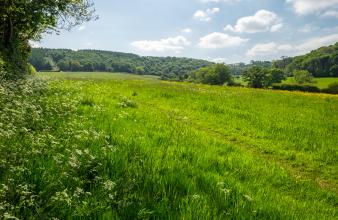
Meadow

Payments for environmental goods and services

UK farmers have access to a range of agri-environment schemes designed to support sustainable farming, biodiversity, climate resilience, and rural productivity. These schemes vary slightly across the four nations of the UK. Here's a summary of the main options:

England – Environmental Land Management (ELM) Schemes

Managed by DEFRA, the ELM framework includes three main schemes:

  1. Sustainable Farming Incentive (SFI)

    • Pays farmers for adopting sustainable practices like cover cropping, nutrient management, and soil health improvement.
    • The 2023 offer is closed, but a reformed version is expected in 2026.
    • Existing agreements will continue to be honoured.
  2. Countryside Stewardship Higher Tier (CSHT)

    • Open from September 2025.
    • Supports actions on SSSIs, woodlands, commons, and historic sites.
    • Includes habitat restoration, climate mitigation, and water quality improvements.
  3. Landscape Recovery

    • Targets large-scale projects for nature recovery, such as peatland restoration and rewilding.
    • Often involves collaboration between multiple landowners.
  4. ELM Capital Grants

    • Funding for infrastructure and equipment that supports environmental outcomes.

Scotland – Four-Tier Conditional Support System

Under the 2024 Agriculture Act, Scotland is transitioning to a new system with increasing environmental requirements:

  • Tiered support includes conditions like:

    • Calving intervals
    • Whole-farm biodiversity and carbon baselining
    • Peatland and wetland protection
  • Schemes include:

    • Future Farming Investment Scheme (FFIS) – £14 million fund for innovation and infrastructure.
    • Knowledge Transfer and Innovation Fund
    • Upland Sheep Support Scheme

Wales

Details are still emerging, but Wales is expected to continue its Sustainable Farming Scheme, focusing on:

  • Habitat creation
  • Carbon sequestration
  • Water quality
  • Landscape-scale environmental improvements

Northern Ireland – Farming with Nature Transition Scheme

This transitional scheme bridges the gap before the full Farming with Nature Programme launches in 2026.

  • Supports:

    • Hedgerow planting
    • Riparian buffer strips
    • Tree planting
    • Winter stubble retention
    • Multi-species cover crops
  • Payments are made after inspection and verification of actions. 

Private and Blended Schemes

In addition to public schemes, farmers can explore:

  • Carbon credit schemes
  • Biodiversity Net Gain (BNG)
  • Water company catchment schemes
  • These often involve long-term contracts and require careful planning to avoid double-counting benefits.

DEFRA Future Farming Blog

This summary contains AI generated content

Related Organisations

Content below is from across the PEP community and is not necessarily endorsed by Stewards or by PEP

Connected Content

There are around 3.2M ha of woodland in the UK. This is set to increase substantially over the coming years due to a range of policy, social, environmental and commercial drivers, including Net Zero, Biodiversity Net Gain, ELMs, Local nature recovery plans and carbon trading.

The Department for Environment Food & Rural Affairs.

The government’s adviser for the natural environment in England. We help to protect and restore our natural world.  

Henry Dimbleby's National Food Strategy, reported in July 2021

ADAS, SRUC and the NFU are looking for farmers and growers to help guide the development of a new

LEAF (Linking Environment And Farming) is the leading charity organisation delivering more sustainable food and farming. They work with farmers, the food industry, scientists and consumers, to inspire and enable sustainable farming that is prosperous, enriches the environment and engages local communities.

Although the term management implies direct manipulation, the practice of wildlife conservation and management includes efforts aimed at preserving or restoring rare species and their habitats and indirect manipulation of wildlife populations through modification of habitat or resources. From: Encyclopedia of Ecology, 2008

SFI offers payments to farmers to carry out farming activities in a more environmentally sustainable way so that they can produce environmental goods and services alongside food.

ADAS Natural Solutions brings together various in-house services to deliver a bespoke solutions based on the requirements of your business. Whether you are looking to increase your biodiversity or achieve net zero, our dedicated team can work with you to create, restore and manage both natural and modified ecosystems. 

One of the schemes of ELMs

What is ELMs? The three-tier Environmental Land Management (ELM

Report published by The Green Alliance by James Elliott, Lydia Collas and Dustin Benton in r

Land use refers to the way that land is used and managed for various purposes, such as agriculture, housing, industry, and recreation.

Farming is intricately connected to the environment in various ways. The relationship between agriculture and the environment is a critical aspect of modern farming practices. Please share information, resources, tools and experiences on the multifaceted dimensions of how farming intersects with the environment.

Help us collate the knowledge sources, organisations and initiatives out there that are seeking to improve the farmed environment

This Topic doesn't yet have a Stewarded summary, but connected groups, content and organisations show below. Click the 'Ask to Join' button if you would like to be a Steward for this Topic and provide a summary of current knowledge and recommend useful resources, organisations, networks and projects.

E-Planner is a free tool developed by UKCEH to help farmers and other land mangers identify the most suitable places for different environmental management actions via easy to use, interactive maps.

The founder and chairman of Environment Bank, Professor David Hill, recently sat down with New Scientist to discuss the future of farming and food. The interview explores how changing approaches to agriculture are essential in preserving the ‘natural capital’ of global biodiversity and prosperity for farmers.

On Friday 26 January, we’re holding a webinar for farmers. During the session, we'll go through the actions and payments available through our environmental land management schemes in 2024. 

Help us to understand attitudes towards SFI schemes and IPM uptake by completing this survey. Anyone completing the survey is entitled to claim a £10 voucher.

An event for Organic, low input and in-conversion farms to highlight changes in farming support payments.

With extreme weather patterns, evolving subsidy schemes and volatile markets the 'goal posts' are constantly changing. At our open day we look and discuss how arable farms can adapt and thrive in the new environment, drawing on the many and varied resources available through Agrii and its Agronomists.

Join us on Thu May 16 2024 at 13:00 in Headley Hall, Tadcaster for an exciting event focused on sustainable biomass production.

A webinar for Organic, low input and in-conversion farms to highlight changes in farming support payments.

Defra's policy document from 2018

Paper published in People and Nature on co-designing Defra's roll out of ELMs. Paul Hur

Write whatever you want here - this is the main section. You can add links, add pictures and embed videos. To paste text from elsewhere use CTRL+Shift+V to paste without formatting. Add videos by selecting 'Full HTML' below, copying the 'embed html' from the source page (eg Youtube), clicking 'Source' above and pasting where you want the video to appear.
You can upload an image here. It can be jpg, jpeg, gif or png format.
Upload requirements

You can upload a file here, such as a pdf report, or MS Office documents, Excel spreadsheet or Powerpoint Slides.

Upload requirements
Authors Order
Add Authors here - you can only add them if they already exist on PEP. Just start writing their name then select to add it. To add multiple authors click the 'Add another item' button below.

Please ensure that you have proof-read your content. Pages will go to an admin for approval before going live.

Configure the meta tags below.

Use tokens to avoid redundant meta data and search engine penalization. For example, a 'keyword' value of "example" will be shown on all content using this configuration, whereas using the [node:field_keywords] automatically inserts the "keywords" values from the current entity (node, term, etc).

Browse available tokens.

Simple meta tags.

The text to display in the title bar of a visitor's web browser when they view this page. This meta tag may also be used as the title of the page when a visitor bookmarks or favorites this page, or as the page title in a search engine result. It is common to append '[site:name]' to the end of this, so the site's name is automatically added. It is recommended that the title is no greater than 55 - 65 characters long, including spaces.
A brief and concise summary of the page's content, preferably 150 characters or less. Where as the description meta tag may be used by search engines to display a snippet about the page in search results, the abstract tag may be used to archive a summary about the page. This meta tag is no longer supported by major search engines.

Meta tags that might not be needed by many sites.

Geo-spatial information in 'latitude; longitude' format, e.g. '50.167958; -97.133185'; see Wikipedia for details.
Geo-spatial information in 'latitude, longitude' format, e.g. '50.167958, -97.133185'; see Wikipedia for details.
Robots
A comma-separated list of keywords about the page. This meta tag is used as an indicator in Google News.
Highlight standout journalism on the web, especially for breaking news; used as an indicator in Google News. Warning: Don't abuse it, to be used a maximum of 7 times per calendar week!
This meta tag communicates with Google. There are currently two directives supported: 'nositelinkssearchbox' to not to show the sitelinks search box, and 'notranslate' to ask Google not to offer a translation of the page. Both options may be added, just separate them with a comma. See meta tags that Google understands for further details.
Used to rate content for audience appropriateness. This tag has little known influence on search engine rankings, but can be used by browsers, browser extensions, and apps. The most common options are general, mature, restricted, 14 years, safe for kids. If you follow the RTA Documentation you should enter RTA-5042-1996-1400-1577-RTA
Indicate to search engines and other page scrapers whether or not links should be followed. See the W3C specifications for further details.
Tell search engines when to index the page again. Very few search engines support this tag, it is more useful to use an XML Sitemap file.
Control when the browser's internal cache of the current page should expire. The date must to be an RFC-1123-compliant date string that is represented in Greenwich Mean Time (GMT), e.g. 'Thu, 01 Sep 2016 00:12:56 GMT'. Set to '0' to stop the page being cached entirely.

The Open Graph meta tags are used to control how Facebook, Pinterest, LinkedIn and other social networking sites interpret the site's content.

The Facebook Sharing Debugger lets you preview how your content will look when it's shared to Facebook and debug any issues with your Open Graph tags.

The URL of an image which should represent the content. The image must be at least 200 x 200 pixels in size; 600 x 316 pixels is a recommended minimum size, and for best results use an image least 1200 x 630 pixels in size. Supports PNG, JPEG and GIF formats. Should not be used if og:image:url is used. Note: if multiple images are added many services (e.g. Facebook) will default to the largest image, not specifically the first one. Multiple values may be used, separated by a comma. Note: Tokens that return multiple values will be handled automatically. This will be able to extract the URL from an image field if the field is configured properly.
The URL of an video which should represent the content. For best results use a source that is at least 1200 x 630 pixels in size, but at least 600 x 316 pixels is a recommended minimum. Object types supported include video.episode, video.movie, video.other, and video.tv_show. Multiple values may be used, separated by a comma. Note: Tokens that return multiple values will be handled automatically.
A alternative version of og:image and has exactly the same requirements; only one needs to be used. Multiple values may be used, separated by a comma. Note: Tokens that return multiple values will be handled automatically. This will be able to extract the URL from an image field if the field is configured properly.
The secure URL (HTTPS) of an image which should represent the content. The image must be at least 200 x 200 pixels in size; 600 x 316 pixels is a recommended minimum size, and for best results use an image least 1200 x 630 pixels in size. Supports PNG, JPEG and GIF formats. Multiple values may be used, separated by a comma. Note: Tokens that return multiple values will be handled automatically. This will be able to extract the URL from an image field if the field is configured properly. Any URLs which start with "http://" will be converted to "https://".
The type of image referenced above. Should be either 'image/gif' for a GIF image, 'image/jpeg' for a JPG/JPEG image, or 'image/png' for a PNG image. Note: there should be one value for each image, and having more than there are images may cause problems.
The date this content was last modified, with an optional time value. Needs to be in ISO 8601 format. Can be the same as the 'Article modification date' tag.
The date this content was last modified, with an optional time value. Needs to be in ISO 8601 format.
The date this content will expire, with an optional time value. Needs to be in ISO 8601 format.

A set of meta tags specially for controlling the summaries displayed when content is shared on Twitter.

Notes:
  • no other fields are required for a Summary card
  • Photo card requires the 'image' field
  • Media player card requires the 'title', 'description', 'media player URL', 'media player width', 'media player height' and 'image' fields,
  • Summary Card with Large Image card requires the 'Summary' field and the 'image' field,
  • Gallery Card requires all the 'Gallery Image' fields,
  • App Card requires the 'iPhone app ID' field, the 'iPad app ID' field and the 'Google Play app ID' field,
  • Product Card requires the 'description' field, the 'image' field, the 'Label 1' field, the 'Data 1' field, the 'Label 2' field and the 'Data 2' field.
A description that concisely summarizes the content of the page, as appropriate for presentation within a Tweet. Do not re-use the title text as the description, or use this field to describe the general services provided by the website. The string will be truncated, by Twitter, at the word to 200 characters.
By default Twitter tracks visitors when a tweet is embedded on a page using the official APIs. Setting this to 'on' will stop Twitter from tracking visitors.
The URL to a unique image representing the content of the page. Do not use a generic image such as your website logo, author photo, or other image that spans multiple pages. Images larger than 120x120px will be resized and cropped square based on longest dimension. Images smaller than 60x60px will not be shown. If the 'type' is set to Photo then the image must be at least 280x150px. This will be able to extract the URL from an image field if the field is configured properly.
The MIME type for the media contained in the stream URL, as defined by RFC 4337.