Abstract
1. Intensive arable agriculture uses agrochemicals to replace ecosystem services (e.g. pest control and soil health) while simultaneously degrading others (e.g. pollination). Agroecological farming aims to reduce this reliance. Whether these practices maintain yields at a scale relevant to farm business viability is unclear.
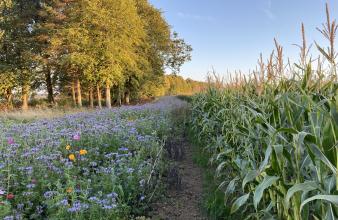
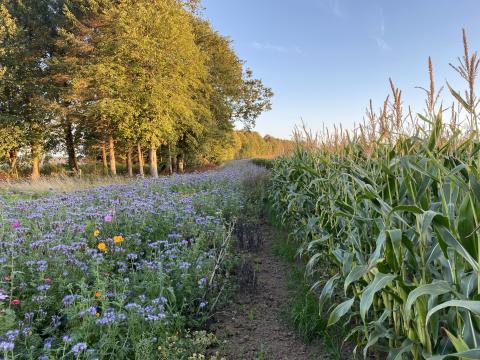
2. In a 4-year replicated study across 17 English farms we assessed the ability of farmer co-designed agroecological systems to support regulating services, beneficial invertebrates, crop yield, and profitability. We test three management systems: 1) ‘Business-as-usual (BAU)’ control; 2) ‘Enhancing-ES’ supporting beneficial invertebrates with wildflower field margins and protecting soils with cover crops; 3) ‘Maximising ES’ with the further addition of soil organic matter and in-field strips to bring beneficial invertebrates into the crop.
3. Soil carbon stocks were highest in the Maximising-ES system. Predation and pollination ecosystem services were higher in the Enhancing-ES and Maximising-ES systems, as were earthworms and other populations of beneficial predatory and pollinating invertebrates. Pest snail biomass was also lowest in the Enhancing-ES and maximising-ES systems, although aphid numbers were higher.
4. The Enhancing-ES and Maximising-ES systems increases yields of cereals and oilseed rape. However, the loss of productive agricultural land and establishment costs exceeded the value of increased yields. Only Enhancing-ES breaks even only with agri-environmental subsidies.
5. These results highlight that while evidence for the role of ecosystem services in supporting crop yield can be found, overcoming economic constraints within conventional farming systems is likely to be a key barrier to widespread uptake. Agri-environmental subsidy payments can offset these costs, but only for moderate interventions. Transition to more sustainable farming systems need to overcome these economic constraints with new policy interventions.
Access the full paper HERE