
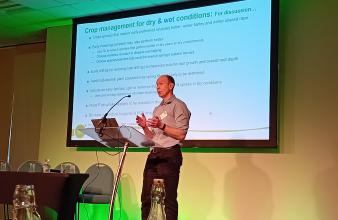

The session started with an audience poll asking:
Which of these factors reduce your crop yields most frequently?
- Drought
- Waterlogging
- High temperatures
- Low temperatures
- Lack of sunshine
Lack of sunshine and drought came out as the top impact on crop yields from the poll.
Definitions:
- Climate - long-term average weather patterns
- Weather - short-term day-to-day state of the atmosphere
Changes to the UK Climate
- UK has been warming at 0.25 degrees C per decade since the 1980s. (Frequency of very high temperatures has increased)
- 2015-24 October to March period was 16% wetter than 1961-1990
- 2015-24 springs were 16& sunnier than 1961-1990
- UK climate projections for hotter drier summers (UKCP18 Science Overview Report)
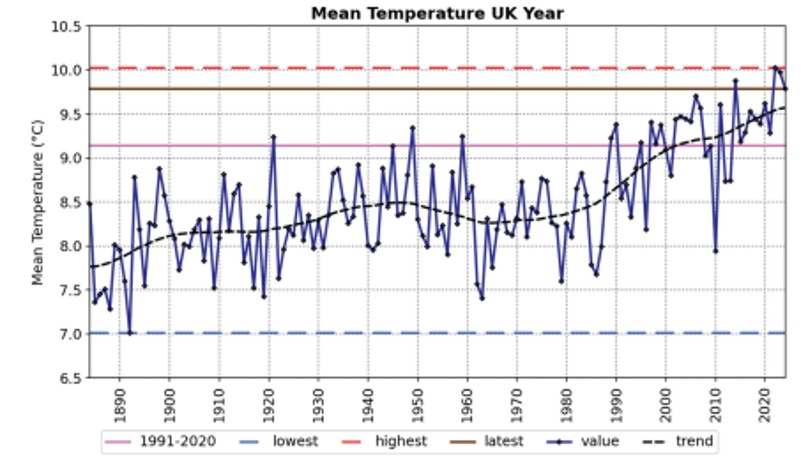

Kendon et al. (2025). International Journal of Climatology
Increasingly variable crop yields

The challenges
- Long-term climate trends:
- The climate is getting warmer
- Greater likelihood of high temperatures
- General pattern of wetter winters and projection of dryer summers
- The climate is getting warmer
- Short-term weather challenges:
- Long periods of dry or wet weather
- Big challenge: Don't know before drilling whether the season will be dry or wet
- Long periods of dry or wet weather
To address these challenges we need a crop husbandry strategy that deals with warmer conditions and the greater likelihood of very high temperatures, while being resilient to long dry or wet periods.
Effect of warmer conditions

- Warm conditions shorten all 3 growth phases, but shorten the production (grain filling) phase the most.
- Warm conditions have a limited impact on the length of the Foundation and Construction phases:
- The start of stem extension depends on a combination of photoperiod (longer days in spring) and vernalisation (exposure to cool temperatures of 0-12 degrees C)
- Flowering date depends of photoperiod
- High temperatures during flowering (>30 degrees C) reduce the number of grains set.
Crop management for warm conditions
- Earlier flowering and grain filling
- Shift grain filling to slightly cooler conditions
- Reduce risk of damaging high temperatures at flowering (but increase risk of frost)
- Reduce water use as less biomass at flowering
- Variety choice
- Ensure sufficient water supply
- Deeper roots
- Earlier drilling (bad for black grass, septoria and some pests)
- Alleviate soil compaction
- Irrigate
- Deeper roots
- Ensure sufficient N and P for canopy longevity (avoid self-destruction)
- Is your fertiliser strategy enough for high yield?
Insufficient nutrients being applied
Current trends show a worrying depletion of soil nutrients, particularly phosphorus.


Effect of dry conditions
In dry conditions, root depth is especially important. The required root depth for a high yielding crop varies based on soil type and rainfall. Consider strategies to improve rooting including alleviating compaction and early drilling.

Action: in a dry year estimate the depth of your roots based on yield, rainfall and soil type.
2025 drought: In 2025, the UK experienced around 40% of normal rainfall from March to June. So how did this effect the 2025 YEN Wheat entries?
Comparison of 2025 YEN wheat with previous years:
- 2025 yields 13% less than YEN average
- Ears/m2: Less
- Grains per ear: Less
- Total Grain Weight (TGW): Greater
- Total biomass: Less
- Harvest index: Slightly greater

Oilseed Rape (OSR) and the 2024-25 growing season
The 2024-25 growing season was an exceptional one for Oilseed Rape. This was due to idea weather conditions and low Cabbage Stem Flea Beetle pressure.
Weather factors associated with high OSR yield (1979-2017) include:
- High Maximum Temperature in October
- Dry December
- Warm min temp March
- Sunny/Dry April
- Wet/Cool May
2024-25 weather & effect on OSR yield

These favourable conditions were reflected in the fact that the three best YEN crops of 2025 were all over 7t/ha.
Crop management for dry conditions:
- Crop species that mature early typically perform better (e.g. winter barley, winter oilseed rape)
- Early maturing varieties may also perfoRm better
- Use AHDBs Recommended Lists to select varieties that perform better in dry years/environments
- Early drilling (or avoid late drilling) to maximise autumn root growth
- Avoid sub-optimal plant population as spring tillering restricted
- Early fertiliser to minimise the risk of slow N uptake in dry conditions
- Consider: early drilling, high plant population, early N will increase risk of lodging and disease , in an average or wet year
- Place P as uptake appears to be reduced in dry spring
- Improve soil water holding capacity
Effect of wet conditions
- Waterlogging
- Nutrient leaching
- Disease
- Lodging
Waterlogging effects
- Shift from aerobic respiration to anaerobic fermentation
- Plant uses up carbohydrate reserves
- Uptake of nutrients is inhibited
- within 48 hours
- Plant stomata close - reduced photosynthesis
- within 72 hours
- Increased nodal root production, chlorosis, premature death of leaves and tillers
- Most detrimental up to tillering (cereals) or green bud (OSR)
- 46 days of waterlogging during tillering reduced yield by 20-24% (Dicken et al, 2008)
Crop management for wet conditions that do not contradict with strategies in dry conditions:
- Choose varieties resistant to disease and lodging
- Choose species/varieties that could be sown in spring if autumn is too wet
- Use urea to help reduce risk of nitrate leaching
- Be ready with a robust fungicide & PGR programme